Orca Slicer is a free, open-source slicer forked from Bambu Studio. The interface is near-identical, files open in either one, and the two sit side by side on the same machine. The differences come down to two things: Orca has built-in calibration tools, and it supports printers beyond Bambu Lab.
If you use Bambu Studio you do not need to learn Orca; you already know it.
Where it came from
Orca started as a fork of Bambu Studio's source. Bambu Studio itself came from PrusaSlicer, which came from Slic3r. All three share a root, which is why the interface logic feels familiar across them. Cura is not part of this family; it comes from a separate root.
Bambu Studio is built to work with Bambu Lab printers only. Orca lifts that limit: Creality, Prusa, Voron, Anycubic, Elegoo and more work out of the box, along with printers running Klipper. I wrote about why trying to add a non-Bambu printer to Bambu Studio is a dead end in a separate article.
Installing
Download from the Releases section at github.com/SoftFever/OrcaSlicer. Windows, macOS and Linux builds are available.
You do not need to remove Bambu Studio. The two install to separate folders, keep separate settings and do not interfere with each other. The same 3MF opens in both.
The real difference: calibration tools
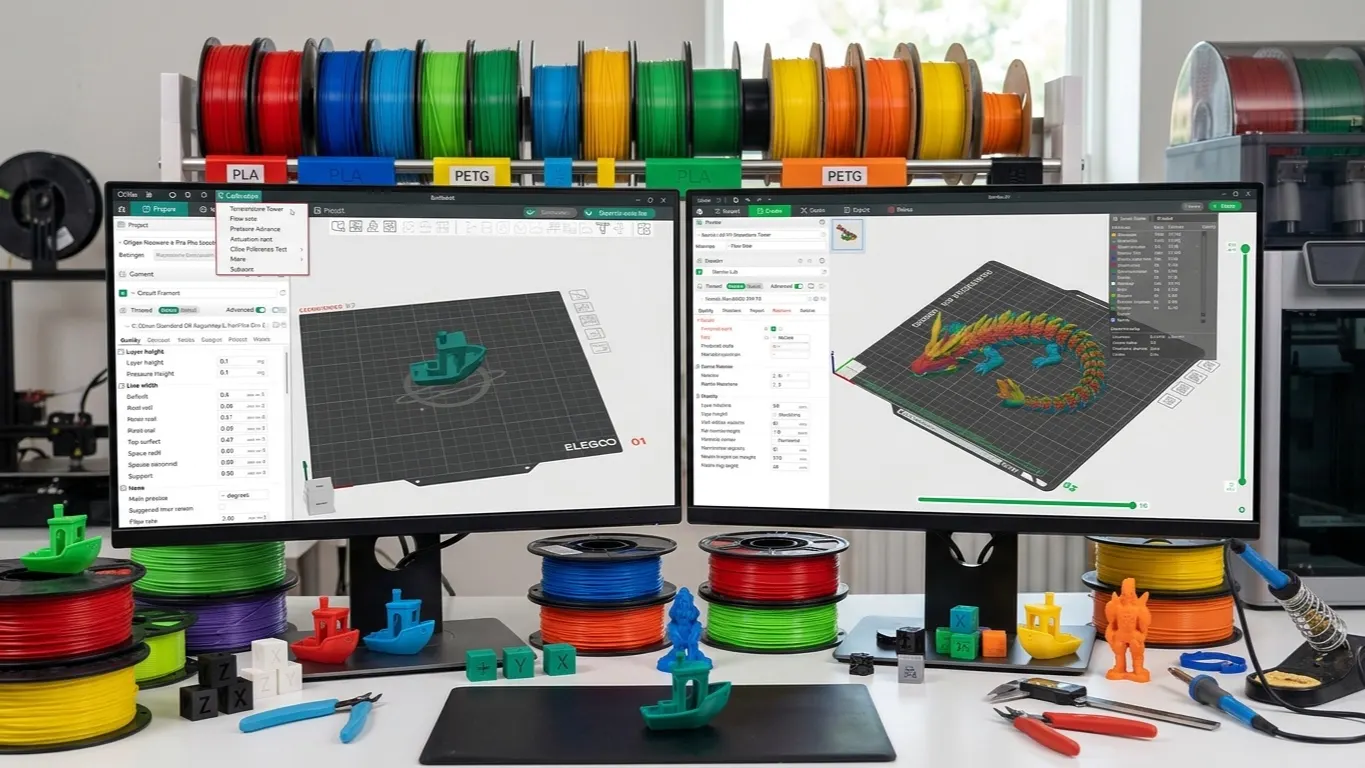
To print a temperature tower in Bambu Studio you have to find a model somewhere and write G-code that changes the temperature layer by layer. In Orca it is a menu item.
Ready-made tests under Calibration:
| Test | What it finds |
|---|---|
| Temperature tower | The right nozzle temperature for the material |
| Flow rate | Flow multiplier: whether wall thickness is right |
| Pressure advance | Bulging and gaps at corners |
| Retraction test | The right retraction for stringing |
| Tolerance test | Clearance for parts that fit together |
| Max volumetric speed | The highest flow the material takes |
Each one generates and slices a model in a single click. You measure the result and enter the value into the profile. These tools are the most concrete reason to pick Orca, especially on a non-Bambu printer with no ready-made profile.
The one people run most is the temperature tower; the temperature tower article covers how to print and read one.
Other differences
More settings exposed. Bambu Studio hides or locks some settings; Orca shows them all. For a beginner that is a drawback; for an experienced user it is the whole point.
Klipper support. If your printer runs Klipper, Orca connects directly.
Faster updates. Because it is a community project, new features land sooner. The flip side is that bugs land sooner too, on interim releases.
No Bambu cloud features. Pairing with Bambu Handy, sending prints over the cloud, MakerWorld integration: all of that stays on the Bambu Studio side. You can reach a Bambu printer from Orca over LAN, but the cloud side is limited.
I have a Bambu printer, which should I use
Use both. The common pattern looks like this:
- Day-to-day printing in Bambu Studio. Cloud, phone app and AMS handling are less trouble there.
- Dialing in a new filament in Orca. Run the calibration tests, note the values, then enter those same values into your Bambu Studio profile if you want to.
Profiles move between the two, so you are not locked into picking one. Importing a profile and then not finding it in the list happens a lot; that article covers why.
Newly released printers
When a new Bambu model ships, Orca support does not arrive right away. Orca is community-developed, and a new machine's profile has to wait for someone to write it; that usually takes a few weeks.
In the meantime you keep running the printer from Bambu Studio. You can build a profile by hand in Orca, but on a brand-new machine that means setting everything yourself, from bed dimensions to flow values. Waiting is usually less work.
You can track whether support has landed in the release notes on GitHub.
Who does not need it
If you have a single Bambu printer, print with stock profiles and are happy with your results, switching to Orca gains you nothing concrete. It just means more settings and more decisions. All four are compared side by side in 3D printing software.
What Orca gives you is control. If you do not need control, Bambu Studio is enough.