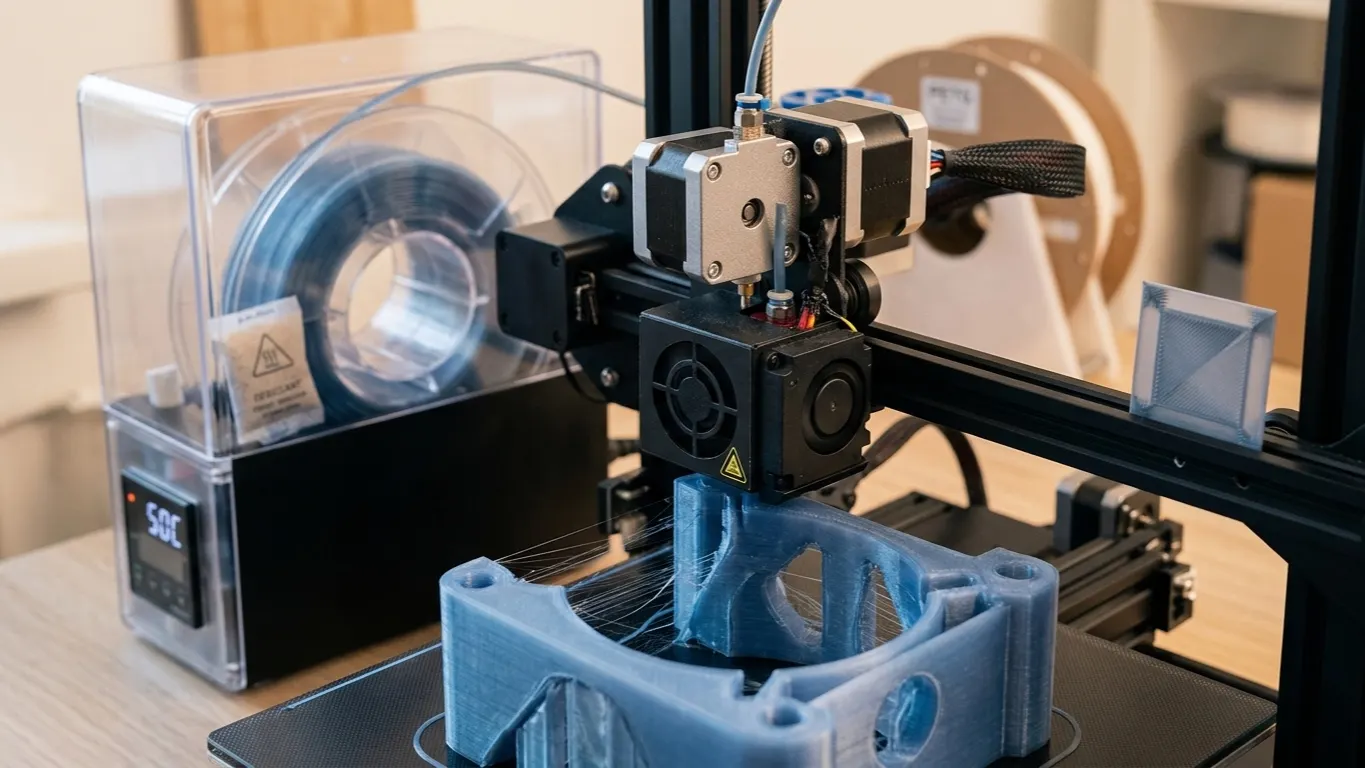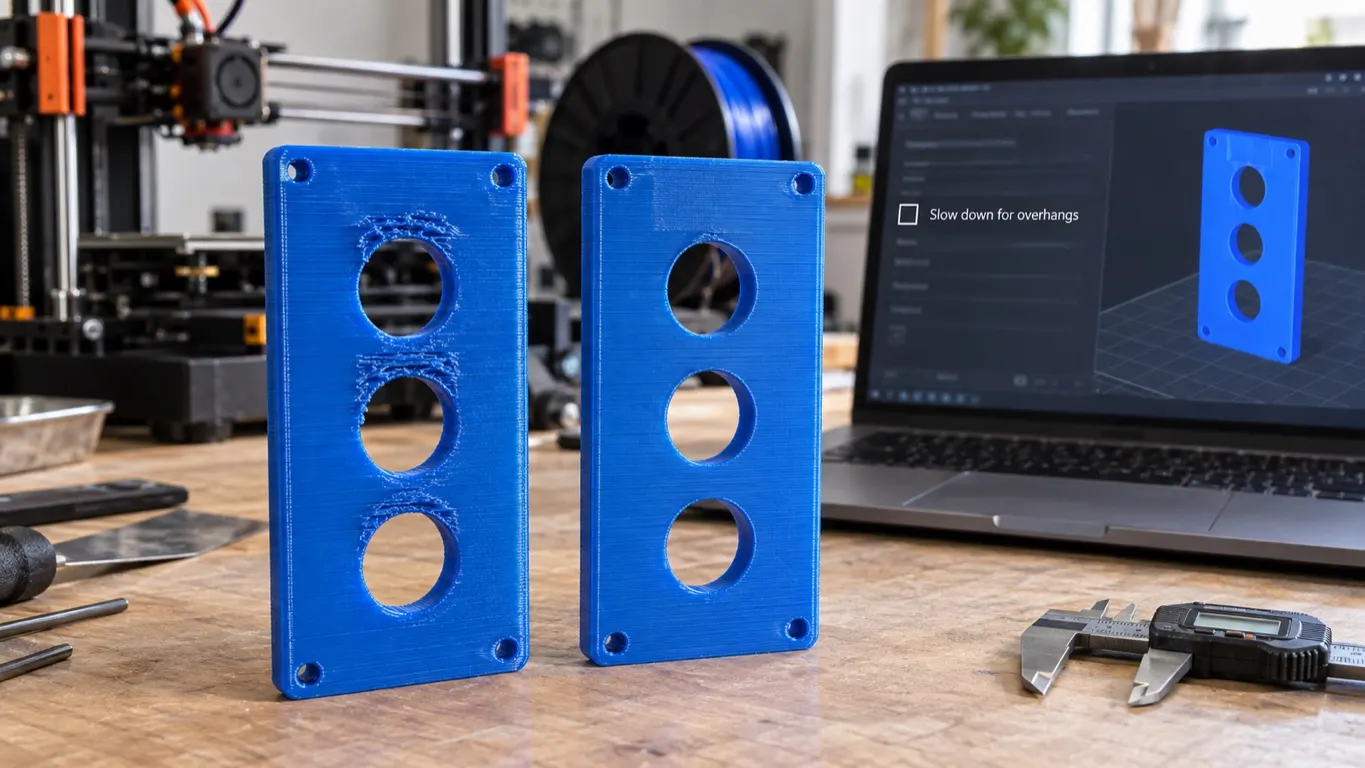
Nylon (PA) filament is one of the harder materials in desktop 3D printing, and most of that difficulty comes from one thing: moisture. Nylon pulls water out of the air far faster than other filaments, and wet nylon will not print. Try it undried and you get crackling, bubbles, gappy walls and parts that snap.
What follows: drying, temperatures, which nozzle you need, and adhesion.
Moisture first
Even a freshly opened spool can be wet. It starts pulling in room moisture within hours of leaving its packaging.
| Value | |
|---|---|
| Drying temperature | 70-80 °C |
| Time | 8-12 hours |
| Time to reabsorb | A few hours in a humid room |
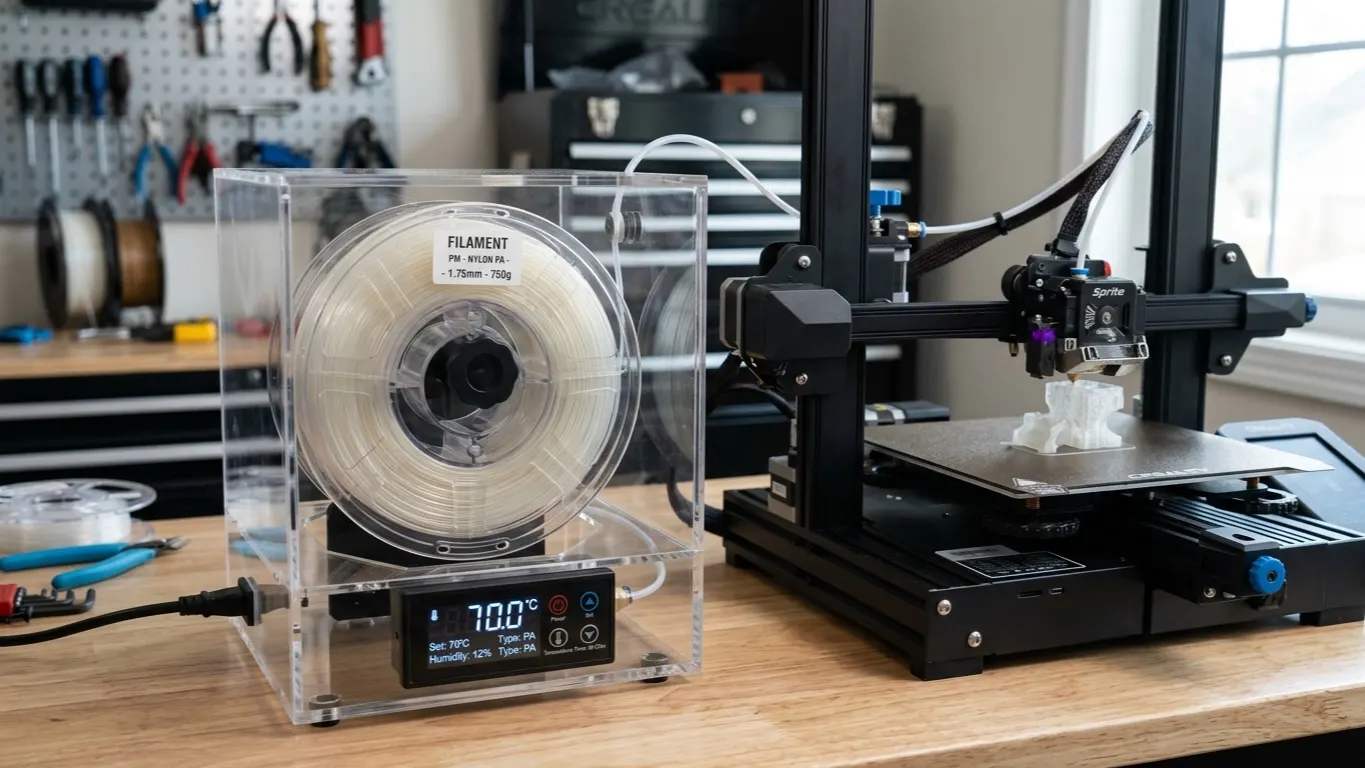
Without a filament dryer an oven can work, but most home ovens will not hold 70 °C steadily and their dial starts at 100 °C. At 100 °C the spool can deform. Do not put a spool in an oven you have not checked with a thermometer.
You also need to dry during the print. Nylon can take moisture back up midway through a long job. The practical answer is to keep the spool inside the dryer and feed the printer straight from it.
How to tell it is wet: crackling and hissing at the nozzle, bubbles in the extrusion, a furry surface, layers that do not bond.
Temperatures
Brands and sub-types (PA6, PA12, glass-filled) vary a lot. Start from the spool label; the range below is the general frame.
| Range | |
|---|---|
| Nozzle | 250-280 °C |
| Bed | 70-100 °C |
| Chamber | 40-50 °C if you have one, otherwise a draft-free room |
You find your temperature with a temperature tower. Orca Slicer has that as a built-in test; in Bambu Studio you have to find a model and set it up by hand. The temperature tower article covers printing one and reading the result.
Nylon prints above 250 °C, so your hotend has to take it. PTFE-lined hotends start degrading the liner around 250 °C and give off fumes. You need an all-metal hotend.
Choosing a nozzle
Unfilled nylon runs fine on a standard brass nozzle. But most nylon filament on the shelf is glass-filled (GF) or carbon-filled (CF), and those fillers are abrasive.
On abrasive filament a brass nozzle widens out within a few hundred grams. A widened nozzle throws off flow and dimensions, and the cause is hard to spot. You need hardened steel or a ruby tip.
Going up in diameter helps too: 0.6 mm clogs less than 0.4 and passes filled material more easily.
Adhesion
Nylon shrinks noticeably as it cools and does not stick well. Bare PEI often is not enough on its own.
What works:
- Glue stick. Cheap, simple, usually sufficient.
- Garolite (G10) plate. The best surface for nylon; it bonds very well.
- Brim. A collar around the base stops corners lifting.
- No drafts. Even without an enclosure, keep the printer away from windows and air conditioning. Sudden cooling is the main cause of warping.
Fan settings flip around here: with PLA you run the fan, with nylon you turn it off or keep it very low. Cooling weakens layer bonding.
Settings summary
A set to start from. Check it against your own material with a temperature tower.
| Setting | Value |
|---|---|
| Nozzle temperature | 260 °C |
| Bed temperature | 80 °C |
| Layer height | 0.2 mm |
| Print speed | 30-50 mm/s |
| Fan | 0-20% |
| Retraction | 1-2 mm, slow |
| Wall count | 3-4 |
| Drying | 70 °C, 8-12 hours, continued through the print |
Speed stays low because nylon bubbles at high flow and layer bonding suffers. I worked out what actually caps your speed in the flow article.
When not to use nylon
Nylon is excellent for gears, hinges, belt pulleys and other wearing parts: tough, flexible, good under friction. It is still not the right material for everything.
On a decorative part nylon's difficulty buys you nothing: PLA is easier and looks better. If you need a flexible part, reach for TPU instead: TPU print settings. If dimensional accuracy is critical, remember that nylon takes up moisture and changes size; even a finished part grows a percent or two over time.